Dhaka 6:24 pm, Tuesday, 27 October 2026

Direct Speech থেকে Indirect Speech

ACECC English Language Club

এসিক ইংলিশ লেংগুয়িজ ক্লাব

Mid-town ( Dhan Mahal ), Gouripur, Mymensingh.

Since: 1st January, 2001

Email:  acecc_creative@yahoo.com  Mobile: 01745213344, 01815030190


Direct Speech থেকে Indirect Speech

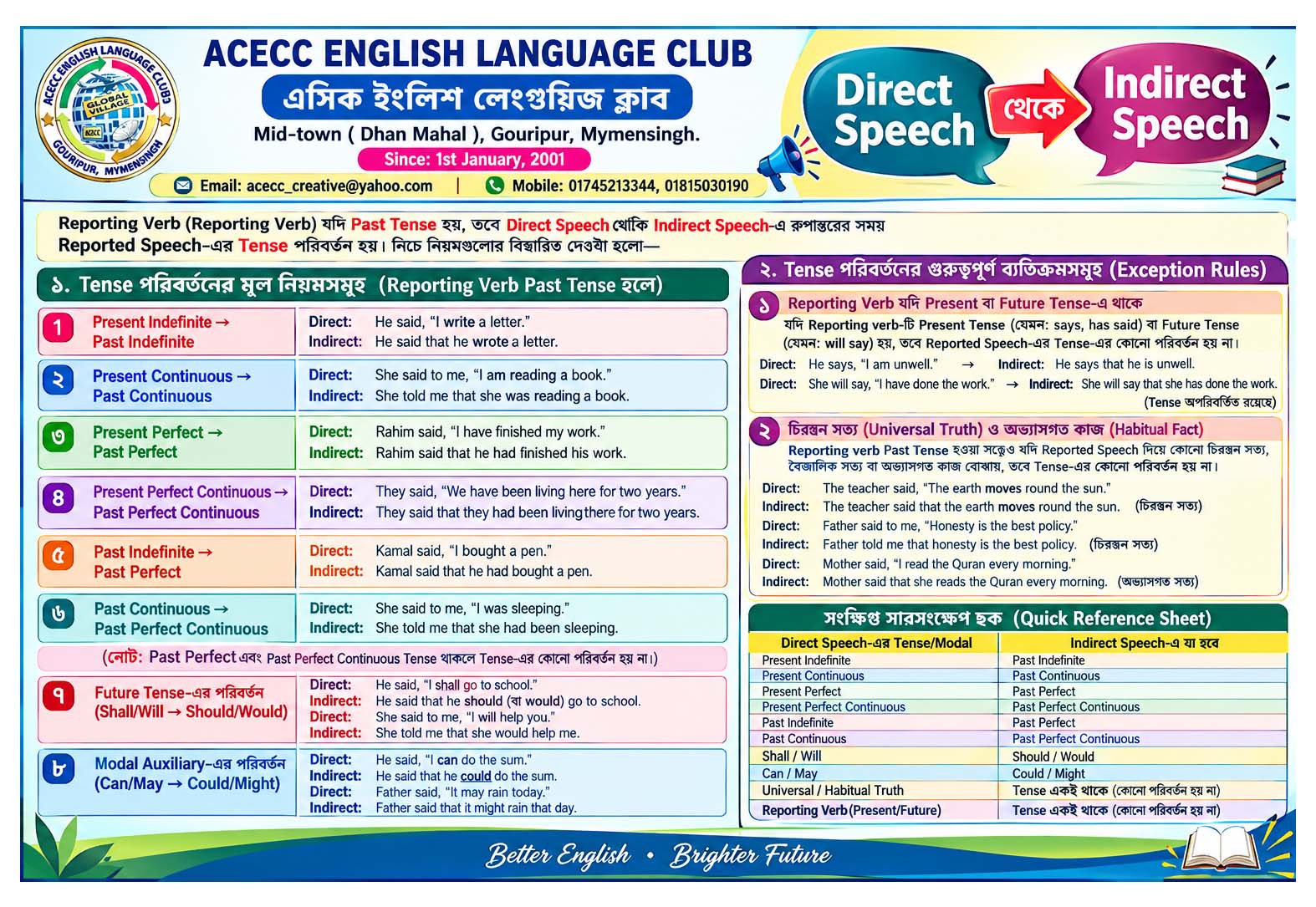
রিপোর্টিং ভার্ব (Reporting Verb) যদি Past Tense হয়, তবে ডাইরেক্ট ন্যারেশন (Direct Speech) থেকে ইনডাইরেক্ট ন্যারেশনে (Indirect Speech) রূপান্তরের সময় Reported Speech-এর Tense পরিবর্তন এবং এর কিছু ব্যতিক্রমী নিয়ম নিচে উদাহরণসহ সহজ ভাষায় বিস্তারিত দেওয়া হলো:

​১. Tense পরিবর্তনের মূল নিয়মসমূহ (রিপোর্টিং ভার্ব Past Tense হলে)


​নিয়ম ১: Present Indefinite – Past Indefinite

​Direct Speech-এ Present Indefinite Tense থাকলে Indirect করার সময় তা Past Indefinite Tense হয়।

​Direct: He said, “I write a letter.” –  ​Indirect: He said that he wrote a letter.

​নিয়ম ২: Present Continuous –  Past Continuous

​Direct Speech-এ Present Continuous Tense থাকলে Indirect করার সময় তা Past Continuous Tense হয়। ​Direct: She said to me, “I am reading a book.” – ​Indirect: She told me that she was reading a book.

​নিয়ম ৩: Present Perfect – Past Perfect

​Direct Speech-এ Present Perfect Tense থাকলে Indirect করার সময় তা Past Perfect Tense হয়।

​Direct: Rahim said, “I have finished my work.” — ​ Indirect: Rahim said that he had finished his work.

​নিয়ম ৪: Present Perfect Continuous –  Past Perfect Continuous

​Direct Speech-এ Present Perfect Continuous Tense থাকলে Indirect করার সময় তা Past Perfect Continuous Tense হয়।

​Direct: They said, “We have been living here for two years.”

​Indirect: They said that they had been living there for two years.

​নিয়ম ৫: Past Indefinite –  Past Perfect

​Direct Speech-এ Past Indefinite Tense থাকলে Indirect করার সময় তা Past Perfect Tense হয়।

​Direct: Kamal said, “I bought a pen.” —​Indirect: Kamal said that he had bought a pen.

​নিয়ম ৬: Past Continuous -Past Perfect Continuous

​Direct Speech-এ Past Continuous Tense থাকলে Indirect করার সময় তা Past Perfect Continuous Tense হয়।

​Direct: She said to me, “I was sleeping.”  –​Indirect: She told me that she had been sleeping.


​(নোট: Past Perfect এবং Past Perfect Continuous Tense থাকলে সেগুলোর Tense-এর কোনো পরিবর্তন হয় না।)


​নিয়ম ৭: Future Tense-এর পরিবর্তন (Shall/Will – Should/Would)

​Direct Speech-এ Future Tense থাকলে auxiliary verb অনুযায়ী shall থাকলে should এবং will থাকলে would হয়।

​Direct: He said, “I shall go to school.”

​Indirect: He said that he should (বা would) go to school.

​Direct: She said to me, “I will help you.”  —​Indirect: She told me that she would help me.


​নিয়ম ৮: Modal Auxiliary-এর পরিবর্তন (Can/May –  Could/Might)

​Modal Auxiliary থাকলে can পরিবর্তন হয়ে could এবং may পরিবর্তন হয়ে might হয়।

​Direct: He said, “I can do the sum.”  –​Indirect: He said that he could do the sum.

​Direct: Father said, “It may rain today.” –​Indirect: Father said that it might rain that day.


​২. Tense পরিবর্তনের গুরুত্বপূর্ণ ব্যতিক্রমসমূহ (Exception Rules)

​১. Reporting Verb যদি Present বা Future Tense-এ থাকে, ​Reporting verb-টি যদি Present Tense (যেমন: says, has said) বা Future Tense (যেমন: will say) হয়, তবে Reported Speech-এর Tense-এর কোনো পরিবর্তন হয় না।

​Direct: He says, “I am unwell.”  –Indirect: He says that he is unwell. (Tense অপরিবর্তিত রয়েছে)

​Direct: She will say, “I have done the work.”  —-Indirect: She will say that she has done the work.


​২. চিরন্তন সত্য (Universal Truth) ও অভ্যাসগত কাজ (Habitual Fact)

​Reporting verb Past Tense হওয়া সত্ত্বেও যদি Reported Speech দিয়ে কোনো চিরন্তন সত্য, বৈজ্ঞানিক সত্য বা অভ্যাসগত কাজ বোঝায়, তবে Indirect করার সময় Tense-এর কোনো পরিবর্তন হয় না।

​Direct: The teacher said, “The earth moves round the sun.”

Indirect: The teacher said that the earth moves round the sun. (চিরন্তন সত্য)

​Direct: Father said to me, “Honesty is the best policy.”

Indirect: Father told me that honesty is the best policy. (চিরন্তন সত্য)

​Direct: Mother said, “I read the Quran every morning.”

Indirect: Mother said that she reads the Quran every morning. (অভ্যাসগত সত্য)


​সংক্ষিপ্ত সারসংক্ষেপ ছক (Quick Reference Sheet)

Direct Speech-এর Tense/Modal Indirect Speech-এ যা হবে

Present Indefinite—–Past Indefinite

Present Continuous——–Past Continuous

Present Perfect——Past Perfect

Present Perfect Continuous——-Past Perfect Continuous

Past Indefinite——–Past Perfect

Past Continuous——————Past Perfect Continuous

Shall / Will—————-Should / Would

Can / May———————Could / Might

Universal / Habitual Truth———–নো পরিবর্তন (Tense একই থাকে)

Reporting Verb (Present/Future)——————নো পরিবর্তন (Tense একই থাকে)
ACECC English Language Club

এসিক ইংলিশ লেংগুয়িজ ক্লাব

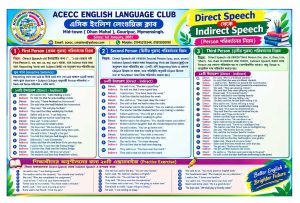
Direct Speech থেকে Indirect Speech ( Person পরিবর্তনের নিয়ম)


​১. First Person (প্রথম পুরুষ) পরিবর্তনের নিয়ম

​নিয়ম: Direct Speech-এর ইনভার্টেড কমা ( inverted commas: “…” )-এর ভেতরে যদি First Person (I, we, me, us, my, our) থাকে, তবে Indirect করার সময় তা Reporting Verb-এর Subject (কর্তা)-কে অনুসরণ করে পরিবর্তিত হয়।

​মূল গঠন (Assertive Sentence):

Reporting verb-এর said to উঠে told বসে (বা said থাকলে saidই থাকে) + কমা তুলে that বসে + Subject (Subject অনুযায়ী Person পরিবর্তন) + Verb-এর Tense পরিবর্তন + বাকি অংশ।


​১০টি উদাহরণ (Direct -Indirect):

​Direct: He said to me, “I am reading a book.”   Indirect: He told me that he was reading a book.

​Direct: She said, “I have finished my homework.”    Indirect: She said that she had finished her homework.

​Direct: They said, “We will play football.”  Indirect: They said that they would play football.

​Direct: Rahim said to me, “I can help you.”  Indirect: Rahim told me that he could help me.

​Direct: Rina said, “I write a letter.”  Indirect: Rina said that she wrote a letter.

​Direct: The boys said, “We are doing our work.”  Indirect: The boys said that they were doing their work.

​Direct: You said to him, “I bought a fine pen.”   Indirect: You told him that you had bought a fine pen.

​Direct: Salma said, “I was ill yesterday.”  Indirect: Salma said that she had been ill the previous day.

​Direct: I said to her, “I have seen the Padma Bridge.”  Indirect: I told her that I had seen the Padma Bridge.

​Direct: The students said, “We love our school.”  Indirect: The students said that they loved their school.


​২. Second Person (দ্বিতীয় পুরুষ) পরিবর্তনের নিয়ম

​নিয়ম: Direct Speech-এর ভেতরের Second Person (you, your, yours) Indirect Speech করার সময় Reporting Verb-এর Object (কর্ম)-কে অনুসরণ করে পরিবর্তিত হয়। ​(নোট: যদি Reporting Verb-এ কোনো Object উল্লেখ না থাকে, তবে পরিস্থিতি অনুযায়ী Object হিসেবে ‘me’ বা ‘him/them’ ধরে নিয়ে পরিবর্তন করতে হয়।


​১০টি উদাহরণ (Direct -Indirect):

​Direct: He said to me, “You are a good boy.”   Indirect: He told me that I was a good boy.

​Direct: I said to him, “You have done the work.”   Indirect: I told him that he had done the work.

​Direct: She said to us, “You must obey the rules.”       Indirect: She told us that we had to obey the rules.

​Direct: The teacher said to the student, “You are making a mistake.”    Indirect: The teacher told the student that he was making a mistake.

​Direct: Father said to me, “You will get a prize.”   Indirect: Father told me that I would get a prize.

​Direct: Mother said to her daughter, “You should respect your elders.”  Indirect: Mother told her daughter that she should respect her elders.

​Direct: He said to them, “You can go home now.”  Indirect: He told them that they could go home then.

​Direct: Kamal said to me, “Your shirt is very nice.”   Indirect: Kamal told me that my shirt was very nice.

​Direct: She said to him, “You were sleeping.”  Indirect: She told him that he had been sleeping.

​Direct: They said to us, “You have won the match.”    Indirect: They told us that we had won the match.


​৩. Third Person (তৃতীয় পুরুষ) পরিবর্তনের নিয়ম

​নিয়ম: Direct Speech-এর ভেতরে Third Person (he, she, it, they, him, her, them, his, their বা যেকোনো নাম) থাকলে, Indirect Speech করার সময় Person-এর কোনো পরিবর্তন হয় না (অপরিবর্তিত থাকে)। শুধু Tense ও অন্যান্য আনুষঙ্গিক শব্দ পরিবর্তন করতে হয়।


​১৫টি উদাহরণ (Direct -Indirect):

​Direct: He said, “She is a brilliant student.”   Indirect: He said that she was a brilliant student.

​Direct: I said to him, “Rahim has passed the examination.”   Indirect: I told him that Rahim had passed the examination.

​Direct: She said, “They are playing cricket.”    Indirect: She said that they were playing cricket.

​Direct: Hasan said, “It is raining heavily.”   Indirect: Hasan said that it was raining heavily.

​Direct: The boy said, “He was telling a lie.”   Indirect: The boy said that he had been telling a lie.

​Direct: Rina said to me, “Suma will sing a song.”    Indirect: Rina told me that Suma would sing a song.

​Direct: They said, “The man has finished his job.”    Indirect: They said that the man had finished his job.

​Direct: Mother said, “Nipa works hard.”          Indirect: Mother said that Nipa worked hard.

​Direct: Karim said to her, “He can drive a car.”   Indirect: Karim told her that he could drive a car.

​Direct: The teacher said, “Tanvir is a intelligent boy.”    Indirect: The teacher said that Tanvir was an intelligent boy.

​Direct: She said, “Her brother lives in London.”   Indirect: She said that her brother lived in London.

​Direct: Father said to me, “They have bought a new garden.”       Indirect: Father told me that they had bought a new garden.

​Direct: Salam said, “Rana will not come today.”     Indirect: Salam said that Rana would not come that day.

​Direct: The girl said, “She knows the secret.”    Indirect: The girl said that she knew the secret.

​Direct: He said to us, “The boys were swimming in the pond.”

Indirect: He told us that the boys had been swimming in the pond.


​শিক্ষার্থীদের অনুশীলনের জন্য ২০টি এক্সারসাইজ (Practice Exercise)

​নিচের বাক্যগুলোকে Direct Speech থেকে Indirect Speech-এ রূপান্তর করো:


​1) He said to me, “I am feeling unwell.” 2)  ​The teacher said to the students, “You should read carefully.”  3)  ​She said, “Rina has completed the assignment.” 4) ​I said to him, “I will visit your home tomorrow.” 5)  ​Father said to my brother, “You have made a mistake.” 6)  ​Rahim said, “They were drawing pictures.”  7) ​Runa said to her friend, “I lost my pen.” 8) ​The old man said to the boy, “You are very honest.” 9) ​Karim said, “Mr. Rahman teaches us English.” 10 ) ​She said to me, “You can take my book.” 11) ​They said, “We have won the championship.” 12) ​The mother said to her son, “You are going to school now.” 13) ​Kamal said to Habib, “Sujon will go to Dhaka.” 14) ​He said, “I was writing an essay.”

​She said to us, “You must practice English daily.” 15) ​The headmaster said, “The students are very attentive.” 16) ​I said to her, “I know your brother.” 17) ​You said to me, “You have done your duty well.” 18)   ​Salam said to his sister, “He is a good doctor.” 19 ) ​The boys said, “We shall play a friendly match.”

Write Your Comment

Your email address will not be published. Required fields are marked *

Save Your Email and Others Information

About Author Information

Direct Speech থেকে Indirect Speech

Update Time : 05:01:08 am, Saturday, 3 October 2026

ACECC English Language Club

এসিক ইংলিশ লেংগুয়িজ ক্লাব

Mid-town ( Dhan Mahal ), Gouripur, Mymensingh.

Since: 1st January, 2001

Email:  acecc_creative@yahoo.com  Mobile: 01745213344, 01815030190


Direct Speech থেকে Indirect Speech

রিপোর্টিং ভার্ব (Reporting Verb) যদি Past Tense হয়, তবে ডাইরেক্ট ন্যারেশন (Direct Speech) থেকে ইনডাইরেক্ট ন্যারেশনে (Indirect Speech) রূপান্তরের সময় Reported Speech-এর Tense পরিবর্তন এবং এর কিছু ব্যতিক্রমী নিয়ম নিচে উদাহরণসহ সহজ ভাষায় বিস্তারিত দেওয়া হলো:

​১. Tense পরিবর্তনের মূল নিয়মসমূহ (রিপোর্টিং ভার্ব Past Tense হলে)


​নিয়ম ১: Present Indefinite – Past Indefinite

​Direct Speech-এ Present Indefinite Tense থাকলে Indirect করার সময় তা Past Indefinite Tense হয়।

​Direct: He said, “I write a letter.” –  ​Indirect: He said that he wrote a letter.

​নিয়ম ২: Present Continuous –  Past Continuous

​Direct Speech-এ Present Continuous Tense থাকলে Indirect করার সময় তা Past Continuous Tense হয়। ​Direct: She said to me, “I am reading a book.” – ​Indirect: She told me that she was reading a book.

​নিয়ম ৩: Present Perfect – Past Perfect

​Direct Speech-এ Present Perfect Tense থাকলে Indirect করার সময় তা Past Perfect Tense হয়।

​Direct: Rahim said, “I have finished my work.” — ​ Indirect: Rahim said that he had finished his work.

​নিয়ম ৪: Present Perfect Continuous –  Past Perfect Continuous

​Direct Speech-এ Present Perfect Continuous Tense থাকলে Indirect করার সময় তা Past Perfect Continuous Tense হয়।

​Direct: They said, “We have been living here for two years.”

​Indirect: They said that they had been living there for two years.

​নিয়ম ৫: Past Indefinite –  Past Perfect

​Direct Speech-এ Past Indefinite Tense থাকলে Indirect করার সময় তা Past Perfect Tense হয়।

​Direct: Kamal said, “I bought a pen.” —​Indirect: Kamal said that he had bought a pen.

​নিয়ম ৬: Past Continuous -Past Perfect Continuous

​Direct Speech-এ Past Continuous Tense থাকলে Indirect করার সময় তা Past Perfect Continuous Tense হয়।

​Direct: She said to me, “I was sleeping.”  –​Indirect: She told me that she had been sleeping.


​(নোট: Past Perfect এবং Past Perfect Continuous Tense থাকলে সেগুলোর Tense-এর কোনো পরিবর্তন হয় না।)


​নিয়ম ৭: Future Tense-এর পরিবর্তন (Shall/Will – Should/Would)

​Direct Speech-এ Future Tense থাকলে auxiliary verb অনুযায়ী shall থাকলে should এবং will থাকলে would হয়।

​Direct: He said, “I shall go to school.”

​Indirect: He said that he should (বা would) go to school.

​Direct: She said to me, “I will help you.”  —​Indirect: She told me that she would help me.


​নিয়ম ৮: Modal Auxiliary-এর পরিবর্তন (Can/May –  Could/Might)

​Modal Auxiliary থাকলে can পরিবর্তন হয়ে could এবং may পরিবর্তন হয়ে might হয়।

​Direct: He said, “I can do the sum.”  –​Indirect: He said that he could do the sum.

​Direct: Father said, “It may rain today.” –​Indirect: Father said that it might rain that day.


​২. Tense পরিবর্তনের গুরুত্বপূর্ণ ব্যতিক্রমসমূহ (Exception Rules)

​১. Reporting Verb যদি Present বা Future Tense-এ থাকে, ​Reporting verb-টি যদি Present Tense (যেমন: says, has said) বা Future Tense (যেমন: will say) হয়, তবে Reported Speech-এর Tense-এর কোনো পরিবর্তন হয় না।

​Direct: He says, “I am unwell.”  –Indirect: He says that he is unwell. (Tense অপরিবর্তিত রয়েছে)

​Direct: She will say, “I have done the work.”  —-Indirect: She will say that she has done the work.


​২. চিরন্তন সত্য (Universal Truth) ও অভ্যাসগত কাজ (Habitual Fact)

​Reporting verb Past Tense হওয়া সত্ত্বেও যদি Reported Speech দিয়ে কোনো চিরন্তন সত্য, বৈজ্ঞানিক সত্য বা অভ্যাসগত কাজ বোঝায়, তবে Indirect করার সময় Tense-এর কোনো পরিবর্তন হয় না।

​Direct: The teacher said, “The earth moves round the sun.”

Indirect: The teacher said that the earth moves round the sun. (চিরন্তন সত্য)

​Direct: Father said to me, “Honesty is the best policy.”

Indirect: Father told me that honesty is the best policy. (চিরন্তন সত্য)

​Direct: Mother said, “I read the Quran every morning.”

Indirect: Mother said that she reads the Quran every morning. (অভ্যাসগত সত্য)


​সংক্ষিপ্ত সারসংক্ষেপ ছক (Quick Reference Sheet)

Direct Speech-এর Tense/Modal Indirect Speech-এ যা হবে

Present Indefinite—–Past Indefinite

Present Continuous——–Past Continuous

Present Perfect——Past Perfect

Present Perfect Continuous——-Past Perfect Continuous

Past Indefinite——–Past Perfect

Past Continuous——————Past Perfect Continuous

Shall / Will—————-Should / Would

Can / May———————Could / Might

Universal / Habitual Truth———–নো পরিবর্তন (Tense একই থাকে)

Reporting Verb (Present/Future)——————নো পরিবর্তন (Tense একই থাকে)

ACECC English Language Club

এসিক ইংলিশ লেংগুয়িজ ক্লাব

Direct Speech থেকে Indirect Speech ( Person পরিবর্তনের নিয়ম)


​১. First Person (প্রথম পুরুষ) পরিবর্তনের নিয়ম

​নিয়ম: Direct Speech-এর ইনভার্টেড কমা ( inverted commas: “…” )-এর ভেতরে যদি First Person (I, we, me, us, my, our) থাকে, তবে Indirect করার সময় তা Reporting Verb-এর Subject (কর্তা)-কে অনুসরণ করে পরিবর্তিত হয়।

​মূল গঠন (Assertive Sentence):

Reporting verb-এর said to উঠে told বসে (বা said থাকলে saidই থাকে) + কমা তুলে that বসে + Subject (Subject অনুযায়ী Person পরিবর্তন) + Verb-এর Tense পরিবর্তন + বাকি অংশ।


​১০টি উদাহরণ (Direct -Indirect):

​Direct: He said to me, “I am reading a book.”   Indirect: He told me that he was reading a book.

​Direct: She said, “I have finished my homework.”    Indirect: She said that she had finished her homework.

​Direct: They said, “We will play football.”  Indirect: They said that they would play football.

​Direct: Rahim said to me, “I can help you.”  Indirect: Rahim told me that he could help me.

​Direct: Rina said, “I write a letter.”  Indirect: Rina said that she wrote a letter.

​Direct: The boys said, “We are doing our work.”  Indirect: The boys said that they were doing their work.

​Direct: You said to him, “I bought a fine pen.”   Indirect: You told him that you had bought a fine pen.

​Direct: Salma said, “I was ill yesterday.”  Indirect: Salma said that she had been ill the previous day.

​Direct: I said to her, “I have seen the Padma Bridge.”  Indirect: I told her that I had seen the Padma Bridge.

​Direct: The students said, “We love our school.”  Indirect: The students said that they loved their school.


​২. Second Person (দ্বিতীয় পুরুষ) পরিবর্তনের নিয়ম

​নিয়ম: Direct Speech-এর ভেতরের Second Person (you, your, yours) Indirect Speech করার সময় Reporting Verb-এর Object (কর্ম)-কে অনুসরণ করে পরিবর্তিত হয়। ​(নোট: যদি Reporting Verb-এ কোনো Object উল্লেখ না থাকে, তবে পরিস্থিতি অনুযায়ী Object হিসেবে ‘me’ বা ‘him/them’ ধরে নিয়ে পরিবর্তন করতে হয়।


​১০টি উদাহরণ (Direct -Indirect):

​Direct: He said to me, “You are a good boy.”   Indirect: He told me that I was a good boy.

​Direct: I said to him, “You have done the work.”   Indirect: I told him that he had done the work.

​Direct: She said to us, “You must obey the rules.”       Indirect: She told us that we had to obey the rules.

​Direct: The teacher said to the student, “You are making a mistake.”    Indirect: The teacher told the student that he was making a mistake.

​Direct: Father said to me, “You will get a prize.”   Indirect: Father told me that I would get a prize.

​Direct: Mother said to her daughter, “You should respect your elders.”  Indirect: Mother told her daughter that she should respect her elders.

​Direct: He said to them, “You can go home now.”  Indirect: He told them that they could go home then.

​Direct: Kamal said to me, “Your shirt is very nice.”   Indirect: Kamal told me that my shirt was very nice.

​Direct: She said to him, “You were sleeping.”  Indirect: She told him that he had been sleeping.

​Direct: They said to us, “You have won the match.”    Indirect: They told us that we had won the match.


​৩. Third Person (তৃতীয় পুরুষ) পরিবর্তনের নিয়ম

​নিয়ম: Direct Speech-এর ভেতরে Third Person (he, she, it, they, him, her, them, his, their বা যেকোনো নাম) থাকলে, Indirect Speech করার সময় Person-এর কোনো পরিবর্তন হয় না (অপরিবর্তিত থাকে)। শুধু Tense ও অন্যান্য আনুষঙ্গিক শব্দ পরিবর্তন করতে হয়।


​১৫টি উদাহরণ (Direct -Indirect):

​Direct: He said, “She is a brilliant student.”   Indirect: He said that she was a brilliant student.

​Direct: I said to him, “Rahim has passed the examination.”   Indirect: I told him that Rahim had passed the examination.

​Direct: She said, “They are playing cricket.”    Indirect: She said that they were playing cricket.

​Direct: Hasan said, “It is raining heavily.”   Indirect: Hasan said that it was raining heavily.

​Direct: The boy said, “He was telling a lie.”   Indirect: The boy said that he had been telling a lie.

​Direct: Rina said to me, “Suma will sing a song.”    Indirect: Rina told me that Suma would sing a song.

​Direct: They said, “The man has finished his job.”    Indirect: They said that the man had finished his job.

​Direct: Mother said, “Nipa works hard.”          Indirect: Mother said that Nipa worked hard.

​Direct: Karim said to her, “He can drive a car.”   Indirect: Karim told her that he could drive a car.

​Direct: The teacher said, “Tanvir is a intelligent boy.”    Indirect: The teacher said that Tanvir was an intelligent boy.

​Direct: She said, “Her brother lives in London.”   Indirect: She said that her brother lived in London.

​Direct: Father said to me, “They have bought a new garden.”       Indirect: Father told me that they had bought a new garden.

​Direct: Salam said, “Rana will not come today.”     Indirect: Salam said that Rana would not come that day.

​Direct: The girl said, “She knows the secret.”    Indirect: The girl said that she knew the secret.

​Direct: He said to us, “The boys were swimming in the pond.”

Indirect: He told us that the boys had been swimming in the pond.


​শিক্ষার্থীদের অনুশীলনের জন্য ২০টি এক্সারসাইজ (Practice Exercise)

​নিচের বাক্যগুলোকে Direct Speech থেকে Indirect Speech-এ রূপান্তর করো:


​1) He said to me, “I am feeling unwell.” 2)  ​The teacher said to the students, “You should read carefully.”  3)  ​She said, “Rina has completed the assignment.” 4) ​I said to him, “I will visit your home tomorrow.” 5)  ​Father said to my brother, “You have made a mistake.” 6)  ​Rahim said, “They were drawing pictures.”  7) ​Runa said to her friend, “I lost my pen.” 8) ​The old man said to the boy, “You are very honest.” 9) ​Karim said, “Mr. Rahman teaches us English.” 10 ) ​She said to me, “You can take my book.” 11) ​They said, “We have won the championship.” 12) ​The mother said to her son, “You are going to school now.” 13) ​Kamal said to Habib, “Sujon will go to Dhaka.” 14) ​He said, “I was writing an essay.”

​She said to us, “You must practice English daily.” 15) ​The headmaster said, “The students are very attentive.” 16) ​I said to her, “I know your brother.” 17) ​You said to me, “You have done your duty well.” 18)   ​Salam said to his sister, “He is a good doctor.” 19 ) ​The boys said, “We shall play a friendly match.”